• As we reflect at the end of the day we all know what it feels like to have had a good day. A day that has left us feeling content with our accomplishments and connected to the world, to other people and to ourselves. We also know what it feels like to have a bad day, one where we have never really found our footing and our groove. These bad days feel like losses in an infinite game – they feel like days we lose and never will be able to reclaim. The difference is palpable. Yet, few people take their time to figure out what a good day really is.

    And it is more important than ever, since the days are now melting into each-other, resulting in an endless mesh of hours interrupted by email and video meetings. We can spend all day in these two activities without feeling that we have made any real progress on anything. Forget about having a good day, we are not even having days anymore!

    The small cues that we could build on, the walk or drive to work, the drive or walk home, the coffee, the lunch break, the chat in the cafeteria – they are all gone. What remains is a lot of freedom, and no way to structure it into that feeling of accomplishment that we all benefit from.

    Caroline Webb wrote a nice little book about how to have a good day and in it suggests that we can achieve a lot if we just start out setting intentions for our day as it starts or, for the next day, as we wind down. There is a lot to be learnt from the examples in her book – and she points out that good days do not need to all look the same.

    The easiest version of having a good day is to set out at the beginning of the day what you want to accomplish, and then do that – so your intention shapes your day. If you get sidetracked you have the three things you want to get done and you can re-focus on them as you take a break or brisk walk to get back to where you want to be.

    Being intentional about the way you spend your time is a great start, but it does not take us all the way to the good day. Your intentions need to compound. You want to be doing work that accrues value over time – building something, refining your craft, writing a book or finishing a project. You want to make progress.

    This is important, and there is a distinction here that I think can turn out to be quite important – and that is the distinction between progress and productivity. We often say that we want to be productive, but that means nothing – if we produce without making progress we are just spinning our wheels and wasting the time allotted to us. So, a good day depends on making progress towards something bigger, a bigger goal broken down into sub goals and small wins.

    A good day contains small wins in an infinite game, moving you forward and creating more opportunities, broader possibilities and new landscapes to explore.

    Intention and progress together bring us closer to the good day, but it is fair to say that we do not always have intentional days of progress, and especially not in a pandemic – so how do we deal with failure? The best way is to recognize failure – and Webb writes about this too – and reboot. Failure is not a moral failing, it is a consequence of being human. We get distracted, we have low energy days, our minds wander. That is not a bug, it is a feature. Welcome it, and then carefully steer back to intention and progress.

    A good day can also be a day where you rebooted and got back on track.

    It is no secret that this has gotten an order of magnitude harder in the pandemic – but I find that interesting. If I can create good days under the current conditions, I expect that it will be easier to do so when the world slowly finds its way back to normal, and that would mean that I could get a post-pandemic benefit from really exploring what a good day is to me now. There has been no better time to understand what we mean by having a good day, and how we can get more of them.

    There is a stoic observation somewhere in all of this, and I think of Marcus Aurelius often these days.

    +
  • This time Richard and I are discussing the early copyright debates and where they went. Who reads Lawrence Lessig today? And what happened to the pirate parties?

    +
  • We are in for a snowstorm tonight, the reports are saying. There is something about being at the mercy of weather that really is refreshing. I have, over the years, become more and more skeptical about city-living, and have enjoyed being ice-locked on an island in the archipelago and now huddling next to the fireplace in our rented cabin in the north. I am working, reading – but I am also connected with the nature around me in a way that feels extraordinary.

    I have found that a lot of friends and colleagues are worn down by the pandemic. I don’t think that they are tired of it or sick of the restrictions, that is not it (and the restrictions have been lighter in Sweden than elsewhere), but I do think that there is something about the way we spend our time that is at work here.

    Some time ago I read a small paper about how women in women’s prisons in the US were developing coping strategies for dealing with the fact that they would spend perhaps decades incarcerated. One key element, the paper noted, was to create really monotonous routines – since those routines work as time compression algorithms. If everyday is the same they compress to the same day in your mind. When you are incarcerated that becomes a coping mechanism, and the compression is your friend.

    When this is what your freedom looks like – when this is the natural state – I think it generates a sense of dull sorrow over time compressed. At some level we are all aware that we have a limited time in the world. The memento mori may not be as articulated as with cancer survivors or others having a near brush with death, but it is there. It touches us, absently, in the middle of the night when we realize that at some time we will leave our loved ones behind and that our children will cover our eyes. It can fill you with a startling moment of deep sadness, but most of the time it just alights like a butterfly and then leaves in the tyranny of everyday things, or better: in the variety of everyday things.

    When the variety disappears, we end up feeling time not slipping away but being compressed. Every day becomes the same, and that makes the thin veil separating us from our demise thinner, more translucent. The routine inherent in pandemic life, the lack of variety, the lack of distraction from our mortality is wearing us down.

    Knowing it will pass is not enough. In a sense we are, to varying degrees, going to be survivors. How will that impact our lives? I know that there are those who think that we will rush to forget it and jump in to a new version of the 1920s, but I wonder if that is true. I, for one, feel more like seeking out other rhythms and paces, finding new contexts and building a good routine around being with family, learning and experiencing. Once the allure of the busy life lifts, it is less likely to put its spell on us again.

    But, hey, on my part it may was well just be age – and maybe the younger generations will jump back into the fray. They should, and it is probably likely they will. And we will emerge not stronger, not weaker – but different from this year.

    Outside the storm is building, eternal and ageless. The snow is blanking out the mountains and other cabins, and in a way it reminds me of the pandemic – it is a different whiteout, where we lose the contours of life and it all melts into a single time.

    +
  • The way you formulate your problem at least weakly determines your solution space. Let’s take a simple example. In Sweden, we have set a goal to have zero deaths in traffic every year. This is proudly referred to as a zero-vision, and is the overarching narrative around how we think about traffic safety.

    Sweden has a low rate of traffic deaths compared with many other countries, and the common assumption is that the zero-vision is responsible for this — but the zero vision was put in place when the number of deaths were already declining fast, in 1997 (the graph is of the number of people dead in traffic:

    The current state of affairs is good – Sweden finds itself at the bottom of the list of deaths in traffic by any number of measures. But we have quite obviously also plateaued. And this where it gets interesting.

    Are we likely to get anywhere if we continue to iterate the zero-vision here? If we do, the kinds of solutions we are looking for tend to be absolute – we will ask the question “how do we get to zero?” – but those solutions, that solution space, seems limited.

    What happens if, instead, we start thinking about relative goals? Decrease the number of dead 5% every year. If we do, we will make progress toward the goal because there will always be something we can do, some small measure that helps.

    This is where incrementalism beats big vision – because in incrementalism you deal with solution spaces that are orders of magnitude bigger than in “vision”-spaces.

    Now, this is not just relevant for traffic issues. It is even more relevant for the big vision political pieces we see coming out with frightening regularity. The EU has turned this into an artform. Every decade or five years it comes out with a paper arguing that in a certain amount of time it will become “leading” at this or that. The Lisbon Agenda was a great example — the EU set the goal to become the world’s leading R&D region with government spending on science the highest in the world.

    This strategy fails, over and over again, and it is not because the EU is not trying — it has summits and writes papers and sets up projects. But the projects are all within the solution space of the question – they deal with how to become leading.

    Would it not be much better to look at relative, incremental goals instead? To increase the spending on R&D 15% a year would be a start. To increase investment in R&D – whether private or public – 15% a year even better. The solution space here is much larger and much more interesting.

    This post almost ends up being a post in praise of incrementalism, you may say. Should we not have visions? Should we not set Big Hair Goals? Of course we should, but we need paths there – and where the vision is the end of the process, the solution space remains small. We need to get much better at mechanism design, and realizing that within the visions and missions we should try to maximize our solution space by asking the relative, incrementalist questions, questions like:

    • Can you make this grow by 10% YoY?
    • Can you increase the pace of this by 5% a year?
    • Are there ways to chip away at the corners here and get us 3% more revenue?
    • How would you go about decreasing complaints just 5%?
    • Etc.

    These questions are more interesting than you think, because they compound. And that is where the visionary change hides, in compounding increments.

    (H/T to Hosuk Lee-Maikyama for the pointer on yet another EU document looking at becoming leading – and as a European I applaud the ambition, heck, it is necessary – but the targets are in absolutes which limits us in growing in two ways – in limiting the solution space as suggest above, and in locking us in to targets that may well be overtaken by the often fast and unpredictable changes in the world. If it is absolute numbers (20 million this, 10000 that) or “cutting edge of quantum computing”, we still end up with the wrong kinds of targets).

    +
  • Tesla has been building factories, and building them fast. Whenever we see a process speeding up, our natural inclination is to believe that it has to do with a change in technology – but in a recent interesting analysis professor Lars Stehn (in Swedish) suggests that there is no such technology at work here. What instead is driving the acceleration, he suggests, is really thorough planning and leadership.

    If this holds up, and it seems likely, it is a stark reminder that processes are driven not just by the speeds of the technologies underpinning them – but equally by what is sometimes thought of as softer factors like planning and leadership.

    Detailed planning is undervalued.

    It is easy to see how this can be true. As everyone ever involved in a home renovation project knows, the key to completition is that all of the involved parties deliver on what they are supposed to deliver and when they are supposed to do so. Renovating a kitchen can be a nightmare of individual delays compounding and worsening the pace to a point where it feels like a neverending story. If all of those delays can be eliminated, the project might well be finished way ahead of time.

    But the planning we are discussing here is different from how we usually think about planning. It is not the strategic planning we engage in when we seek to figure out how to deal with an uncertain future, but the tactical planning required to drive projects to completition.

    This skill, to plan projects well and to lead them, is likely to be a key skill in a society that is trending towards more and more complexity – and yet still we do not value it enough and what nascent progress was made in fields like operations research is today thrown out as not ”agile” enough.

    Here is a question:

    Could it be the case that our stubborn declaration of the death of planning and our disdain for gantt charts and careful planning, in favor of new forms of project management like Scrum is creating faster subprojects, but leave us powerless to deal with delays stemming from the connection between these projects into a larger plan?

    Nothing is as unfashionable today as meticulous planning – yet, when it is applied it seems to yield significant progress – in companies like Amazon and here with Tesla (and arguably as a part of some of the industrial speed shown by countries like China).

    Maybe the decline of detailed and meticulous planning is closely related to the increased complanceny of Western economies?

    +
  • Adrian Daub’s book on Silicon Valley thinking is intended as a criticism of the ideas that underpin the Silicon Valley-ideology, if there is one. This in itself is a worthwhile project, and teasing out the intellectual underpinnings of different spheres in society is in itself a good form of critical philosophy. It is fair to say that Daub is writing in the tradition of Jacques Ellul, Neil Postman and, more lately, Evgeny Morozov.

    The book is divided into different sections dealing with different themes identified by Daub as the core themes in Silicon Valley thinking and in these Daub discusses various subjects, such as the genius cult and the disregard for content that he feels that he can read out of Silicon Valley culture, or, to be precise out of corporate Silicon Valley culture.

    The book runs into a problem here. Daub is aware of, and writes extensively about, the counter cultural roots of some of the technology culture that he describes, but he assumes that it is now absorbed into corprorate structures and subverted into meaningless TED talks and empty PR-speak – but that is not entirely true. He, himself, is a professor at Stanford and there is a broad counter cultural community still left in the Bay Area. Look at the recent political shifts in downtown SF or at organizations such as the Foundation for the Long Now — these are signs that the counter culture is alive and well, so what Daub seems to limit himself to is the the way that “Corporate Silicon Valley” speaks.

    By missing this distinction, Daub paints his target with too broad a brush and doesn’t engage with the fundamental ideas that still organize a lot of the discourse around technology in the region. That is a pity, because he is clearly very well-read and argues forcefully — so wasting that energy on a strawman version loosely put together seems unnecessary.

    It is also part of the current discourse of technology criticism, itself a genre that has become lazy in the face of absolutely no resistance whatsoever.

    If we were to critique Daub’s book with the same low-resolution analysis we would end up saying things like this:

    • Daub suggests that Silicon Valley is idolizing the dropout in order in order to advance a weird elitism anti-elitism that allows them to ignore accumulated knowledge, but instead of arguing for a less elitist model his critique slips back into the original, academic elitism, suggesting that tech entrepreneurs have only a shallow understanding of what are really complex problems only understood through years of academic study and university lectures.
    • Daub suggests that Silicon Valley is economically dependent on content, but refuses to engage with it – devaluing it both in partnerships and in moderation of their platforms. Content, he thinks, is a key driving force, but in doing so he reduces the people who use the technology to bystanders without any agency at the same time as ignoring the enormous explosion of creativity and content that the Internet has brought about.
    • Daub wants desperately to paint Silicon Valley tech bros as adolescent Randians focused on individual independence and rationality, but in doing so engages in the same rote simplification you find in the TED-talks he despises. Yes, there are people who read Rand in the Bay Area, but it is the most communitarian and liberal-leaning area in much of the US — so claiming Rand is the intellectual lodestar here is clearly not just a stretch argument, but a disappointingly sensationalist one.
    • When Daub turns to trolls he produces an interesting essay that is entirely decoupled from any analysis of Silicon Valley. The communication patterns that he is studying are not typical or unique for the area, and he makes this point himself, so claiming that the troll is a Californian species is not only not credible, but borders on guilt by association.
    • For someone intent on criticizing the shallow argument offered by tech thinkers, Daub suprsingly often falls for the temptation to make quick jabs and lazy attacks. In an otherwise interesting chapter on Girard and mimetic desire – and there is something to his criticism here – he writes “It’s highly dubious that Girard would have thought that the PayPal mafia was the solution to mimetic desire. Thiel likes the PayPal mafia so much he renders it sacred”. This is tweet-level trolling, from the mouth that condemns it.

    We could go on, but let’s not. I think the reality is that this book is an important read. A book that could have been more, and should have been more, than it ended up being. I think Daub should have written that book. In that book we would have had to face harder questions, like questions around how progress and technological innovation really should be coupled in a democratic society or questions around what the Internet should evolve into if we could build it further into the future. It could be a book about the history of ideas clashing here – Ellul, Postman, Winner and on the other side the likes of Herman Kahn, John McCarthy (with his extreme optimism) and Herbert Simon. Or why not a real discussion about the ideas of Hannah Arendt and Simone Weil as key missing elements in the intellectual endeavor undertaken in the Bay Area.

    Because this is the thing: a majority of tech leaders are interested in the intellectual debate about their industry and, in my albeit limited experience, committed to understanding how to best solve the fundamental challenges we are facing. That is quite the audience to be addressing – compare that with the leaderships and elites of past decades!

    That is, I think, why it is so disappointing to see tech criticism succumb to the formulas and gestures of generic capitalist critiques.

    But Daub’s book can be read for the nuggets of constructive criticism it contains as well, and that alone makes it worth your time (some resist this idea of constructive criticism – I remember Morozov telling me in a chat at Google that it was not his job to come with alternatives, that Adorno had it right when he said that the criticism should not engage in alternatives but tear down the edifice and then stand back – I can respect that, but think it, personally, a waste of time).

    +
  • So in this episode we get to know Richard Allan, hear about his engagement in archaeology and politics and learn a bit about what led a random Swede to work in tech policy for more than 20 years!

    Listen in here.

    +
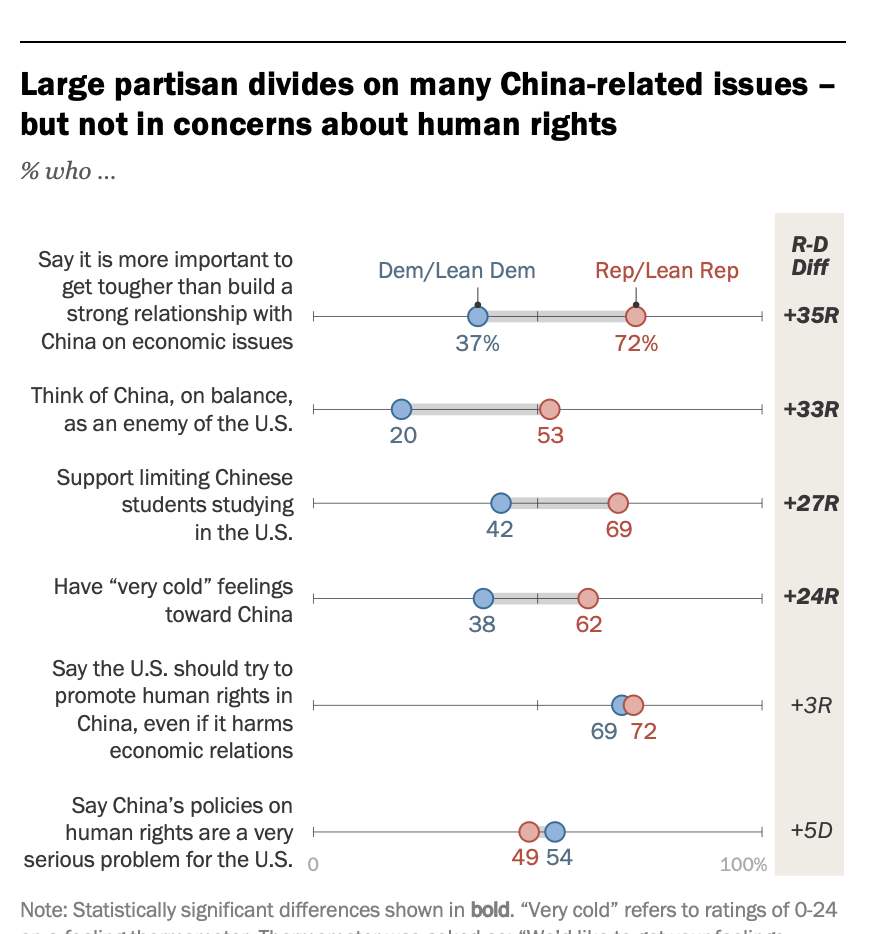
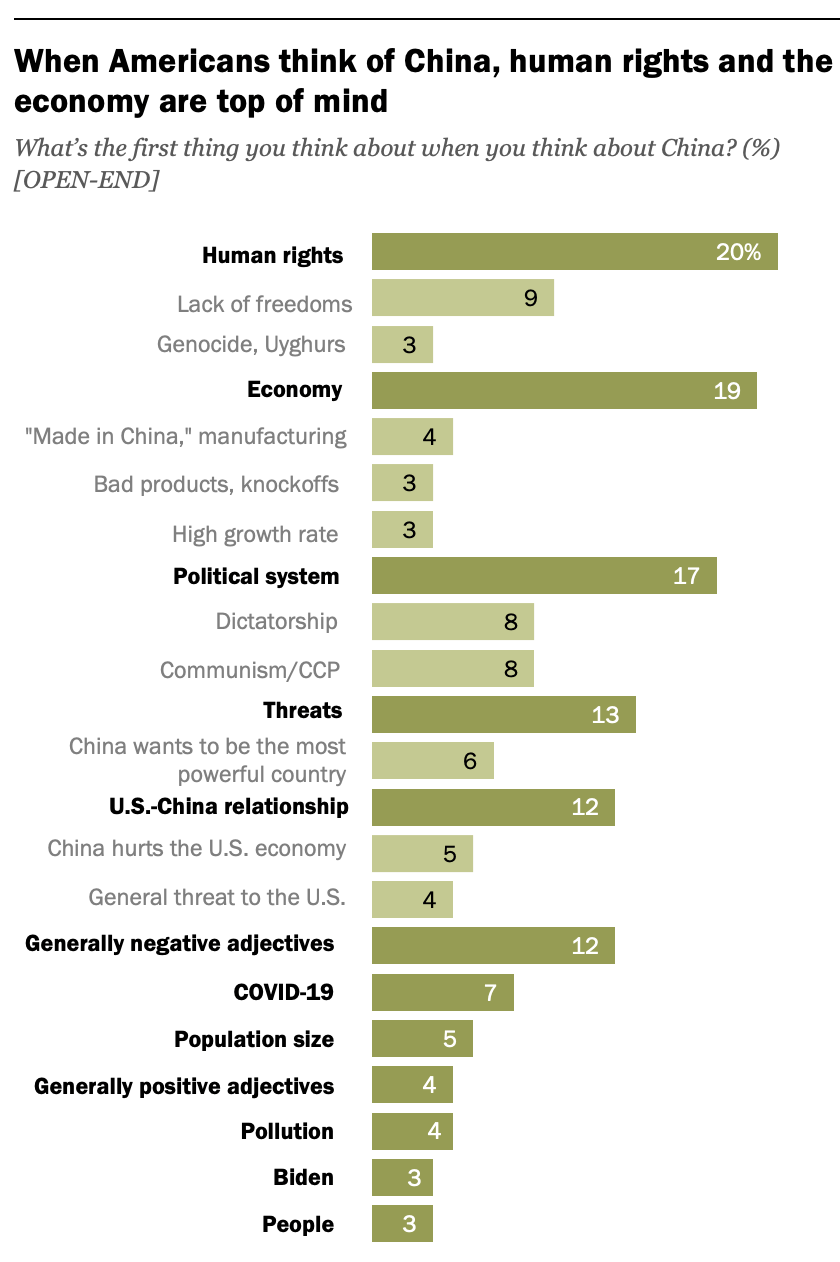
  • In a newly published survey, the Pew Research Institute is looking into how Americans view China. The outcome at first glance seems unsurprising: Americans are increasingly skeptical of China, and are concerned about China across a number of different dimensions. But when you look more closely at the numbers you cannot but notice something interesting, and it has to do with what kind of concern this is.

    This chart, looking at the republican / democratic divide is a case in point:

    The structure of bipartisan agreement on how to handle China is oriented around the issue of human rights, not about any real threat from China to the US. We can simplify and tease out the narrative here: The US thinks of itself as a democracy responsible to speak up on and deal with human rights issues, and not as an empire about to be replaced by a rising China.

    It would be very interesting to see what a similar survey in China would look like. Would Chinese be equally concerned with the US, and across what dimensions? The Chinese narrative is around the recovery from past humiliations and the rightful rise of China as a world power, I think, and this clash of narratives is likely to structure the relationship in important ways going forward.

    Other interesting data that indicate the same thing:

    The US-China relationship would look very different if the category “Threats” was the top one, and especially if the “China wants to be the most powerful country” trended to the top.

    The NPR reported another interesting aspect of this – that Chinese trust in the state increases as US sentiment grows more negative. US negative views are consolidating the Chinese around their narrative.

    In any geopolitical analysis the relationship between the US and China is one key aspect, and the way the two countries view each-other is an interesting way of cutting the data.

    +
  • All organizations occasionally should stop and consider the risks and opportunities facing them, and discuss both mitigation options for the risks and exploitation options for the opportunity. There are many different ways of doing this, but one of the simplest frameworks is the tried and tested impact / probability matrix. What you do is list all possible risks (or opportunities) first in a small group. Every risk gets written down on a post it and posted on a wall or whiteboard, and then you start mapping them in a two dimensional chart that looks at every risk’s probability of occuring and the possible impact that it will have:

    Impact can be calculated in many different ways, but should probably be a compound measure of at least the following qualitatively assessed properties: the cost of the risk (low, medium, high), the degree to which the risk reduces future options (low, medium, high), the differential in competition (does this risk affect only us – again low, medium, high) and the recovery effort needed (low, medium, high). All of these are related and overlapping, but the point is to fermize the impact over a couple of different concepts to ensure that you get a good sense of the risk.

    The probability should be assessed by looking at percentages, but retaining the uncertainty in the percentages. One way of doing that is to define a risk interval within which you think the risk is situated with +75% likelihood. That is an intellectual kludge, but it allows you to paint the risk through that interval:

    By doing this you have started to map the risks, and now you can add a matrix to the chart to classify the risks in different ways. One commonly used categorization is the following:

    Now, the next thing you want to do is to take the risks in the upper right corner and organize them on two different dimensions – yield and effort. This step is often overlooked, but that is a mistake. If you really want to think through risks and opportunities you need to also think through your ability to impact and mitigate the risks. Once you organize them in that matrix you get something that looks like this:

    Now, when you organize your risks in the following way you will see which ones you should start working on – and it is not the top right corner. The heroic risks attract a lot of attention, but if you do not start with the low effort, high yield risks you are making a strategic mistake. The low effort, high yield – the no brainers – is always what you should do first, and then you should prioritize according to yield effort and work through hard, operational and thankless risks before you even try your hand at the heroic risks. Often, addressing heroic risk requires a singular organizational focus and commitment. Do you have that? If not, create it before you try. The risks we are looking at in this quadrant are quests, with great payoffs but a ton of work!

    This framework will get you some way towards thinking through risk in your organisation.

    +
  • On Gesellschaft and Gemeinschaft, in Svenska Dagbladet and Under Strecket – available here. And a chance to think about duckrabbits!

    +