I am now ditching the invite only mode for the newsletter. I feel confident that I have a form for it that I like, and so I would appreciate more readers and think I will learn more from a broader readership.
I have now written 20 issues of the letter and I think the form is slowly evolving to where I want it to be, so now it is also mature enough to show the world. Looking forward to comments and ideas from anyone who wants to join.
It turns out that there is no such things as trees or crabs. Yet, a lot of things end up in crab-shapes or tree-shapes. What is happening here? This is a question that is related to the work on physics and evolution put forward by people like Geoffrey West, especially in his bookScale; evolution ultimately unfolds under certain basic conditions and these conditions then echo in the way evolution maneuvers in the fitness landscape. A slight preference for the energy dispersal efficiency in trees – well, then expect trees. Interestingly this suggests that there may be more global (not global) solutions and more local solutions in the phylogenetic tree, if one reads it that way.
Trees are solutions to evolutionary problems that are branch independent.
If we really want to speculate we could then suggest that this means that there is a higher probability that we will find trees and crabs when we first encounter aliens, that evolution operates within a physical solution space that is more narrow than we may have realized.
Noting this here to ensure I find some more literature on phylogenetics as problem solving.
A culture is guided by its concept of happiness, and how that is located in the overall grammar of human existence – and our society is one that is focused on living a happy life. A result of that is that we often ask ourselves if we are happy – whether consciously or not. We compare our level of happiness with others, and then translate it into a basket of variables like wealth, relationships, autonomy, where we live and what that looks like et cetera.
The grammar of happiness is weighted towards new and exciting events, so we seek vacations that will create the memories that we can put in the basket to increase our happiness (even if we may not enjoy the actual vacation as much as pointed out by Kahneman) and we document only those moments that qualify. You could, in a sense, read the grammar of happiness from the pattern of social media updates and photos we share, and we can perhaps back out our own concepts of happiness from which such posts and images we like.
I don’t think that is fake or wrong, by the way. The idea that we only show our best lives in social media and that this creates a plastic and inauthentic culture has it the wrong way around — it assumes that social media is a cause and not just an expression of our overall culture. It is ”the internet made me do it”-thinking, a special version of psychological repression of our own agency, a repression that is easier than accepting responsibility for who we are and what our society has thus become – but that is another discussion.
Neither do I think it is given, in the sense that we cannot change who we are and what society then becomes. But it is not about making sure the algorithms are transparent or that advertising is prohibited – it is about how we think about the core concepts in our lives. The somewhat disappointing and often bitter hypothesis that things are the way they are because things are the way they are, and not because of our actions is what I think Socrates had in mind when he noted that the unexamined life is not worth living.
If we examine life, our core organizing concepts – justice, happiness, fairness – we live a life that is open to change and direction, if we do not we end up stuck in concepts that have a logic of their own and will guide us down paths that are in a sense pretermined. It could be correct to say language made me do it! At least much more correct than blaming any other extraneous cause.
With that we can return to the question of how the concept of happiness guides us, and ask if there are patterns in there that we should care about, and if we do so I think there is one dimension in this concept that is interesting to look at – and that is the tension between the everyday life and the adventure or project.
When are you most happy? When you are having coffee in the morning, in a quiet room or with the family around or when you are lounging on a balcony in a nice hotel at a small island in the Mediterranean? I am only partially kidding! These two dimensions in happiness are interesting because of how they seem to guide us into two different paths.
It is a cliché to point out that near death experiences shift the center of gravity in happiness towards the smaller things – towards the experience of everyday moments and their mysteries. But what happens when an entire culture has had a near death experience? What happens after a war or … a pandemic?
So here is the hypothesis: after the pandemic we will see a shift in the grammar of happiness towards smaller things, simpler moments – less career, less wealth, less trips. More simple things – like a dinner with friends, a party, a beautiful morning with a cup of coffee.
This is not all good – and some would say that it could be disastrous. Tyler Cowen has pointed out that the lack of ambition and the complacency of the Western world is the real cause behind the perceived slowdown in innovation and progress that he claims we have seen in productivity growth and real technological change the last couple of decades — we have become a civilisation celebrates its own accomplishments, blind to the possible improvements. If the hypothesis is correct our interest in progress and big, mission-like economic projects or technological projects may be waning.
And worse: a culture that enjoys the little moments will see its horizons shrink and time become more focused on the now – and that at a time when we really need to think long term and deal with issues like climate change! So a contented, small things happiness may actually be a myopic enjoyment of the music at the deck of the Titanic as she plunges towards the dark, cold depths of the ocean.
When our sense of urgency shifts from the adventure to our everyday things we become weaker in the aggregate, as a culture. Perhaps.
These things are not meant to be simple. Happiness is for better or worse a powerful concept, and one that we have to keep under close scrutiny – to paraphrase; the limits of our happiness are the limits of our futures – personal and societal. And there is an argument for abandoning happiness as the organizational concept for human experience (Nietzsche noted that happiness was, at the time he wrote, not a very big thing outside of the English world – and perhaps one of the larger, hidden, changes in our collective mentality in the last centuries is this slow colonization of our thinking by the idea that we should be happy – that thesis is not new, but remains an interesting line of exploration).
If not happiness, then what? One answer would be that we need to move from a mono-conceptual organization of life to a pluralistic one, where more than one single concept structures our reality. Aristotle’s Nichomachean Ethics notes that no man should be judged – or can be judged – happy before the end of his life. In that, admittedly alien to our time, framework happiness is a summing up of a life well lived through the balancing of virtues and actions that make us human, not happy – and develop us in different ways. A life of learning, perhaps.
It will be interesting to track our overall mentality over the coming decade – the possible return to the roaring 20s, or the slow refocusing on the everyday experiences, and perhaps the abandonment of happiness as a conceptual framework for how we live.
If nothing else recognizing when we act under the logic of happiness is a helpful way to live a perhaps more examined life.
This nice book waited in my mail as I came home from the mountains:
I had the privilege to write a chapter in it about how utopias have evolved, and devolved, over the last couple of decades. To my unbridled joy my contribution also contains a reprint of Lubberland!
Almost everyone has heard about the notion of “six degrees of separation” – that there are six jumps between any two persons in, say, the US. The experiment or game actually originates in a short story by Hungarian author Frigyes Karinthy, The Chain, where the object of the game was to connect two random individuals. It was then popularized by experiments where social scientist Stanley Milgram tried to send a package to a person in Boston and started with a random set of people who then only could send it on via someone they knew. The result – popular culture has it – was around 6 degrees of separation between any two people in the US (the actual experiment had a much more difficult outcome, and was not as clearcut). The hypothetical rule was also sometimes formulated as a logarithmic correlation between separation and size of the population.
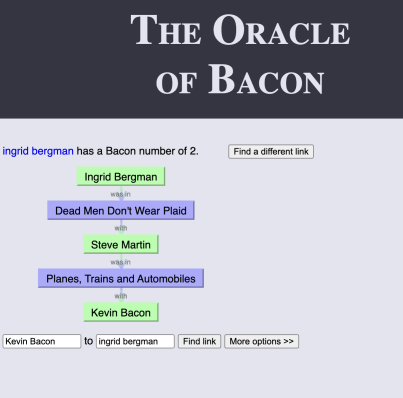
Several different studies have been made of networks, determining their degrees and discussing what is sometimes referred to as the “small world”-phenomenon. Duncan Watt’s reimagined Milgram’s experiment with email and arrived at an average number of people an email had to go through on the Internet was 6. One of the most interesting experiments was the “six degrees of Kevin Bacon”, looking at how to connect any actor with Kevin Bacon.
Ingrid Bergman has a Bacon number of 2
The result – an actors Bacon number – describes how many jumps it takes for an actor to connect with Kevin Bacon. The average Bacon number in the network is around 3 (and Kevin Bacon is not the most connected – there are others that are closer to having an average actor-number of 2).
All in all, different networks of different sizes seemed to conform to the idea that group size and degrees of separation are heavily connected. Families are super connected, villages are close to professional networks and as we move up through cities to nations and the world we see greater and greater degrees of separation. In a simple picture:
Now, this is in itself interesting, and you could start asking questions about this relationship. Why is it that we see this correlation? What is it based on? Here we enter open speculation, to be clear, but let’s play with explanations. Maybe one explanations is that we are limited to how many people we can have social relationships with? This would lead us down the path to the Dunbar number, proposed by Robin Dunbar as the maximum number of connections we can have given our biological, neurological capacity (Dunbar arrived at it by comparing brain size in primates and group size). The Dunbar number is a round 150 people, and if we imagine that the world fragments naturally (in some biological sense) into groups of 150, then maybe this could explain the degrees of separation growing in the way they do.
But if we invoke the Dunbar number (admittedly controversial) we are suggesting that there is some kind of causation between biology and the degrees of separation and brain size and our inherent ability to correlate a group. The degrees of separation partly start to resemble a collective cognitive limit or a social organization limit. Let’s draw this out in all of its consequences to see if there is a there, there: societies would, under this line of speculation, have an optimal degree of separation and that is what we have detected – the six degrees.
Ok, so why is it optimal? What is it that is optimized by the six degrees of separation? And how is that connected with the Dunbar number? Here is where I want to go with this – I think you could argue that Dunbar has given us more than a limit of the group size of primates, the group size is actually the size of the most efficient evolutionary unit for any specific primate. If larger groups and more friends and a higher Dunbar number had been evolutionarily advantageous we should have seen it in evidence — group sizes in fish and birds are different and not related in the same way to brain size, so why is brain size the limiting factor for primates? Because – wait for it – we think together. Intelligence is a network concept. We think together and so the size of our groups are optimized for collective problem solving and thinking.
Then, to keep that as we scale up in group size, the degrees of separation reflect the fact that we are still keeping to those Dunbar-sized groups to continue thinking efficiently together.
We are deep into guesswork here, but it is interesting to just pursue this thought experiment a little further, I think. We can now ask what happens if we change the degrees of separation across different groups. Dunbar groups have a single degree of separation, and as they grow and connect to other Dunbar groups we see the logarithmic growth of separation with group size. What happens in our thought experiment if we reduce the degrees of separation in really large groups? What is it that changes – do we become better thinkers or do we do worse on cognitive tasks?
Here I think the answer is – although maybe controversial – that we become much worse thinkers if group size increases and degree of separation is held constant. We simply cannot process or think with that many people, or brain then moves from cognitive modes to ways of trying to reassemble the smaller groups around us. A hyper connected large network component is unable to think, and its collective intelligence falls fast because it is constantly overloaded by ideas, views, information and data.
Our thought experiment might even allow us to say that hyperconnected large network components, several orders of magnitude beyond the Dunbar groups, are unable to create and sustain knowledge.
Let us now turn back to today. How is technology changing things? One of the cliché observations often through-out there is that technology connects people. What this should mean is that technology is slowly reducing the degrees of separation, and yes – this is exactly what we find. Facebook researchers have shown that the Facebook network component – which is very large – is increasingly connected, and the degrees of separation have gone down from 4.74 to 4.57. It is 4.67 at Twitter (see here). In our picture:
So, what then happens to a social group when we reduce the degrees of separation? The group seeks its former stability and in doing so it reverts from what Julia Galef calls “scout mind” – a knowledge seeking position – to soldier mind, where we seek to reform the group through having the same views, in an attempt to regain the stability of the Dunbar group.
If our thought experiment is correct, we would end up with the insight that connecting people is what drives them apart, what really polarizes them, as they try to regain their ability to think together. Polarization is really an attempt at increasing degrees of separation.
Now, there are several weaknesses in this argument, and it is interesting to look at those too.
First, we could argue that the overall degree of separation in a network component does not reflect the fact that there can be many sub groups and that these can uphold the Dunbar requirements – so why should the average degree of separation concern us? I think this is fair, and just saying “our society is more connected, so polarization is the natural reaction to increase separation” may be far to simplistic – but that does not mean that we could not see that effect on top of several still working, smaller groups. Society as a whole may suffer and smaller groups still remain healthy, and in fact, the tension then between society and these groups would only increase polarization – but this time not along political as much as social dimensions.
Second, we could deny that there is any value in the Dunbar findings at all and suggest that technology actually augments our capacity to interact with more people, and so we should expect that the solution to our problem is if we can go back to village cognition globally for the entire human network. The way forward is shrinking the degrees of separation not trying to increase them, and what we need are new modes of thought. We need to re-learn thinking in groups and start thinking in hyper connected networks. This is a skill, not an evolutionary trait, and we should be optimistic about our ability to do this. I find this hypothesis alluring, but also slightly utopian – I am not sure if it is right, but think it is worth taking seriously. My worry is that we are constantly underestimating the biological limitations of technology use, and that this forgetfulness of our biological nature leads us into solutions that increase the mismatch between the Wilsonian layers – “our paleontological feelings, medieval institutions and godlike technology.”
Third, we could argue that polarization is really just the consequence of inequality and that inequality is the result of political choices or the lack of such choices. Talking about degrees of separation and Dunbar groups really just hides the ball. Our emergency, you could argue, is political – not biological, and not scientific, and not dependent on any abstruse network qualities. This view has a lot to recommend it, and I am not saying that there is not a political problem as well — but maybe the ability of our political system to solve problems has to do with the cognitive ability we collectively command? If so, it seems it could be worthwhile asking if we are better or worse at thinking together now.
Fourth, you could argue this is a pessimistic view of mankind, technology and the future – and that things have improved massively with ever lower degrees of separation. I would disagree with this — I actually think that if we can start to unravel institutional and biological mechanisms of social problem solving we will be better off, and if that means that we increase the degrees of separation that will just lead to better decision, and I am quite optimistic that we can do this. There is another thing here too. If we look at our little chart, we find that greater degrees of separation actually also can be loosely related to greater political freedom, or at least liberty. The city has more political freedom than the village, and the family has none. It seems as if the tighter the social cohesion, the less individual freedom. This leads us to the surprising, but interesting idea that individual freedom requires more degrees of separation. And technology can be used for both connecting people and increasing the degrees of separation — and I would predict that some of the technologies that we will see in the coming decades may actually help us do exactly that.
To be clear, I am not blaming social media at all for connecting people – I think we want to be connected, and that two evolutionary imperatives (belonging to a group and retaining social distance for thinking) are at conflict here. The solution is not less social media, but more innovation along the lines of smaller groups and greater degrees of separation. Room size limits modeled on the Dunbar number, network component max sizes, sub-networks — it can all be done really well and lead to a coming re-separation rather than disconnection between people.
This is important – it is not about disconnecting people, it is about increasing the degrees of separation in the connections themselves.
Well, just a thought experiment. But an interesting one, I think.
Economist Thomas Schelling made an important observation in his Nobel prize talk in 2005 when he said:
“The most spectacular event of the past half century is one that did not occur. We have enjoyed sixty years without nuclear weapons exploded in anger.”
This observation is no less true today, but we can add a worrying conjecture to the observation – and the conjecture is this: as the memory of what nuclear weapons look like and the effects they have fades, so does the deterrence effect they have in game theoretic analysis of conflict.
Thomas Schelling’s note on nuclear weapons is even more important today.
In a sense the deterrence effect fades with every year they are not used.
We could hope that this means that their importance also has lessened and that they simply have slipped away from the strategic analysis of war, but that seems optimistic. There are a handful of conflicts where nuclear weapons might actually still be used by those who shun no means to not lose a war (rather than winning it).
My own generation grew up under the ever-present threat of nuclear war between the US and Soviet Union. We had exercises where we all ran to bunkers underneath the school. We watched cheesy movies like Wargames and listened to cheesy songs like Sting’s Russians.
In the song Sting sings “In Europe there is a growing sense of hysteria” – and we now are in the opposite state. We are in a world where there is a growing sense of complacency around nuclear weapons, and this, in itself, may paradoxically mean that we are living in times that are more dangerous than we realize.
Well, no doom mongering from me, but the theoretical problem underpinning this is still relevant — deterrence is related to memory. The deterrence of nuclear weapons was co-constructed by popular culture and we see nuclear weapons nowhere in popular culture today, there is no sense of humanity having constructed a weapon that can truly and well wipe out all life and the real madness in the so called theory of “mutual assured destruction” (MAD). I remember reading a book about this when I was around 14, where the term “overkill” – the number of times each side could destroy the planet – made such an impression on me that I still think about it occasionally.
I think this is the reason my generation is somewhat blind to the risks we are facing, we are still within the larger shadow cast by Hiroshima and Nagasaki, but the generations growing up now are growing up without any memories of a culture that contemplated its capacity for suicide. To be fair today’s kids don’t have it easier, they are growing up under a pandemic with the shadow of terrorism as a real risk, and I think their sense of uncertainty will have an interesting effect on the choices they make (and could work out in a good way, with them seeking progress as the antidote to uncertainty!).
Deterrence effects fade with time, generation over generation.
So, what can we do? Not much, one may say – but maybe at least remind ourselves more forcefully that we brought ourselves to the brink of one version of the Great Filter and walked back from it, and that we are still standing close enough to the abyss to peer into it.
One key problem for the church in medieval times was to explain why raising the dead, defying the elements and conjuring things was not magic. The challenge here was that Jesus did all of those things, and if they were interpreted as magic, then Jesus would be a wizard or sorcerer, not the son of God. So – being human, and hence really brilliant about making conceptual distinctions (that is what we are good at after all — to both our benefit and detriment), they declared that the acts of Jesus were all miracles, not magic.
Wait, you might say, that sounds like a distinction without a difference, but it is not. Miracles are not created by the individual, but by God himself – they are exceptions in the fabric of reality granted by the maker. Magic is about individual acts of rending that fabric and creating something out of nothing, bending the rules of our frail reality to one’s own will. That is a real difference – miracles happen, magic is wrought.
Ok, this is a simplification, and there are a lot of details here that I am leaving unattended, but it is a useful simplification because it allows us to look at technology and ask if technology is a miracle or magic. Does it happen, no matter what, or does it empower us to act?
This is not such a farfetched question – a lot of the debate about technology does paint us as a victim of technology – technology made us vote for Trump or Brexit, it made us write nasty things on the Internet, it eroded our creativity, it made us into bad parents or substandard pupils in school, it disrupted democracy, it created geopolitical tensions, war and genocide.
This view of technology is a view of technology as miraculous.
Now, if we believe that all of those actions we commit come from within some sort of agency, then technology become magic – and we did all of that, but with tools far more powerful than we can imagine and so what technology really did was reveal flaws in our character.
That is a view of technology as magic.
Both of these metaphors are interesting to explore. The first absolves us from personal responsibility and may place some responsibility on the deus absconditus or advertisus of large tech companies, but largely focuses on technology as such. The second does not say that technology has no role, but asks a classical question that gothic literature has been asking for centuries – how much power can a person wield?
If we agree that technology is more like magic than miracles, the question becomes if we are dabbling in things “no human was meant to know”? That is a tricky question – but an interesting one. And it leads us to a whole philosophy of knowledge that is not obviously present in todays discussions: the debate between Kant’s enlightenment and the medieval prohibiting against aspiring for higher things.
Underlying the debate about technology, the Internet and the overall discussions about how society is changing we can find this old debate about what we should know.
Kant’s suggested that we should dare to know, and that was a clear break with earlier ages prohibition against seeking higher things (“Seek not the things that are too high for thee, and search not into things above thy ability: but the things that God hath commanded thee, think on them always, and in many of his works be not curious.” as the Bible has it). If the problem with technology is that it gives us power we do not understand, well, that is a return to the biblical pre-enlightenment perspective.
And it is not easy, because at the heart of this question about knowledge is a question about the nature of man — should we remain as we are and not seek change or development? Or should we seek to grow and know more all the time? Surprisingly the magicians side with Kant, as the miracle believers side with the medieval biblical thinkers.
This exposes an interesting, and lost, aspect of enlightenment — that it sought all kinds of knowledge and really believed that the universe was – as it was for Newton – a cipher from God to be deciphered not just in the language of science, but in the language of all intellectual systems and technologies available. And, indeed, as Keynes noted – Newton was not the first scientist, but the last of the great magicians.
Our narrowing of knowledge to that which is scientific has brought us great progress, and that progress is taken as evidence for its accuracy and value. But if we accept that, it seems that we should accept that more knowledge is better, and that there is no line we cannot cross, no domain of knowledge that should remain close to us. We should seek the power – and often it will be an individual power – of technology not resist it.
A word on power being individual — we are thinking about this as a society, and we are trying to restrict the use of technology across a number of different dimensions with collective institutions and law, but those attempts assume a level of shared influence over technology, even though technology creates individual power – and so we end up in a society that ultimately wants to restrict access to technology and control the use of it.
Now, imagine replacing technology in this argument with magic — and this is a common theme in much Fantasy literature – and we see how hard it is to limit access to technology, and how technology will be sought if not by the good guys at least by the bad guys, and so it will come into this world. This idea – sometimes called the technology completion conjecture – suggests that all that can be invented will be invented. It is not a crazy idea – especially not if we imagine that technology and magic are closely related. What can give us individual power, will be something we aspire to unlock.
These mental models – magic and miracles – are not just fun, they are also useful for thinking about how we approach issues of knowledge, our nature and the future of technology.
A simple model to think through (for flaws as well as merits): industrialization was a process with efficiency as the core competitive dimension, informatization is a process with learning as the core competitive dimension — in a coarse grained model this would almost correspond to the different dimensions in evolution; the first adaptation to the environment (efficiency) and the second adaptation to other adaptive systems (learning). Increasingly efficiency becomes table stakes, and competition, in this model, converges on red queen evolution, where it takes all the running you can do to remain in the very same place.
The fact that background extinction rates remain (somewhat) constant over large periods of time really brings this home, and suggests that we should expect to see continued failure rates remain constant in the economy. It also suggests that failure rates in the economy is the best measure of the economy’s health – so turns the focus, at least in some ways, to bankruptcy rates and the uniformity of these over the economy (i.e. they should not just end up in one sector, be clustered – or?).
Compare two ideal type economies – one has a uniform failure rate of about 25% and the other a clustered failure rate of 2.5% aggregated – which one should we invest in? And why?
The problem here is that the bankruptcy signal is noisy, and often seen not as an index of the health of an economy, but as a problem or an index of if the economy is going badly. The fundamental question of when companies go bankrupt is often answered with causes outside of the individual company, i.e. companies go bankrupt when the economy is bad.
If, instead, we could say – and I am not saying that we can today – that companies go bankrupt when their business model as a whole (including things like execution, logistics etc) fails, then the signal would be more interesting, and we should want some turnover in the economy, and look for ways of increasing it.
The European Union numbers suggest fewer bankruptcies than ever during the pandemic:
The US numbers suggest more:
But again, these are very noisy numbers and not sure there is a lot that can be read out of them – especially not on the back of a pandemic. But there seems to be something here that could be useful as a means of analysis.
Here is the long term rate in the US:
I did not find any longer than 1980, but an interesting question would be if there is a change in pattern of bankruptcies as we enter the information economy for real, and what that would mean — and if we are, maybe, looking at a shift in pattern here.
Now, of course, if you start looking at the delta things become more interesting (it is in the EU chart) for the US, here are new started businesses:
You see an intriguing divergence between newly started businesses and bankruptcies — how to understand that more in detail? One possibility is that we are also witnessing a shift to single person companies in the gig economy, so we should expect more companies in absolut numbers and so a lower percentage of bankruptcies (as these bankruptcies would in principle be personal bankruptcies and a different kind of signal). Intriguing.
There is noise there too, it turns out:
The numbers are affected by the shift in legislation to prevent abuse of personal bankruptcy (i.e. getting out of debt consciously assumed by declaring bankruptcy) — so not clear how to read or understand. Well, well — more to do, and generally: a focus on failure rates and failure modes is almost always an interesting way to examine any phenomenon. How things break / change / fall apart over time is a key to how they evolve (forgetting builds memory).
In Ernst Mayr’s essay ”What is Darwinism”, there is a section on multiplication of species, in which Mayr notes that there still is a lot that we do not understand about speciation and how it occurs. This is interesting for a number of different reasons, but one small thing stood out to me in the essay – and that was that Mayr suggests that there are 5-10 million different species of animal and 1-2 million species of plant in the world.
Now, if this still holds it suggests an interesting question about the relative proportions of plants and animals – if these different kinds of speciation are holistically meaningful – in a biosphere. Is there an optimum relative proportion of different species, and if so – why?
It seems the overall composition of the biosphere is an intriguing question, as well as the question of what different sets of biospheres – compositionally – are viable. Is Earth an example of a rich biosphere or would alien life be as speciated as life here on earth for a reason?
If so – what is that reason, and what is the limiting condition that drives towards that kind of diversity and proportion?