• 2022 was a reasonably eventful year, for me personally (the year globally is not the subject of this post). I took on a new job, at DeepMind, as global policy director. I also moved to London and now share my time between London and Stockholm, exploring what it feels like to live in two cities (it is very different, but not in a bad way – it does force perspective changes!).

    Work-wise, the year has been filled with a lot of learning. DeepMind is a fascinating company, and the people I have met have been generous to a fault with their time and insights. The sense of mission-driven purpose and commitment is both inspiring and humbling. The AI-space has gone through massive change and rapid acceleration the last year as well – and that means that there is more work to be done to ensure that the policy dialogues we need are happening, and that we put a robust policy framework in place for the future. Reconnecting with the OECD, EU and other policy makers over these issues has been a real pleasure. We often underestimate the political systems we work in, but I consistently find serious, committed and curious people working on the issues. Cynicism about policy remains an uninteresting defense mechanism for those that cannot see the necessity of messiness in politics. For me, work is valued along a couple of different dimensions – the people, the learning and the mission – and I feel fortunate to be where I am at this moment in history.

    I have lost weight, started weight lifting and am in generally better shape than I was last year, which feels very good. As I grow older I value time more and more – and time is more valuable if one is healthy, so that is increasingly important to me. I never thought I would enjoy weight lifting as much as I do, either, but it is a great form of exercise – especially if one gets a great personal trainer, as I was lucky to do.

    In terms of writing, the year has been good. I concluded the newsletter Unpredictable Patterns, having written 99 notes over two years, on various subjects. Each note was roughly 3000 words and the discipline of writing these notes weekly did a lot for my writing, I think. As I now turn to other writing – books, blogs and short stories – I will need to keep that up. I also wrote some in Swedish in Svenska Dagbladet – essays on Roe vs Wade, Cheap Speech (the book and concept), semiconductors and power as well as the importance of quitting. I also had the privilege to write about US politics and the distinction between comprehension and competence that DC Dennett makes, in Axess. In terms of longer essays elsewhere, I wrote an essay about the how digitization reaches a point where it stops revealing nature as a resource and instead allows nature to hide in complexity – something I also had a chance to discuss in this podcast. I also had the opportunity to write a short piece on AI and eternal life in the catalogue for the Nobel museum’s exhibition on that theme at Liljevalchs.

    I have read a lot – and have discovered some new authors. Top reads this year include everything by Ruth Millikan on the biological nature of concepts, Lorraine Daston on rules as well as on observation generally, as well as Edward Chancellors on the history of interest. I also enjoyed the grand theory of history in Bradford De Long’s latest work and Annie Duke’s book on quitting.

    Richard Allan and I have continued to explore tech policy in the podcast Regulate Tech – and have produced 20 episodes this year on a variety of subjects. My favorite ones included The End of Silicon Valley and Richard’s knowledgeable take on the Online Safety Bill in the UK. More than anything I enjoy the conversations we have, since I learn something every time we sit down.

    There is much more to be said about 2022, but I think it might be good to conclude with a few thoughts on 2023. There are three things (that is how Peircean I am) that stand out in how I want to focus the year. One is on things that compound over time, and really digging in on a few longer projects to get them done. The second is a deepening of the health project overall, looking at diets and other habits to see what can be changed. The third is being meticulous about how I spend my time. It may be a function of getting older, but I do feel that the way we spend our time is increasingly the only thing that matters – not in the sense that we should save time or just spend it more leisurely, but that we should spend it in ways that help us become what we need to be.

    You are what you repeatedly do and the habits we form describe the shape of our time in ways that we should not ignore. If anything I aim to craft my time more intentionally in 2023, looking for ways to learn differently.
    +
  • The sun is setting over Camden. A new work week is coming up, and we are not sure who we are – or who we will be. Most of us are becoming. I met a man in the street today, walking down to buy some groceries, who walked slowly, elegantly dressed and speaking to a friend beside him. He looked as if he knew exactly who he was. There is beauty in that, but also a special kind of horror. To be done, a finished piece of music, only to be performed over and over again (oh, and the special horror of that performance that seeks to cast the work in a new light by cheap tricks and juxtapositions).

    And we, who are drafts, envy the sense of completion – but we do not realize that it means that there will be no change. A finished sketch, a short story carefully worked out and then? Laid aside as a step on a longer journey. I think this is why we should not pursue happiness. It is a desire to be finished, to be laid aside. Our desire for happiness is an echo of Freud’s thanatos – remember that the god of death in Greek mythology appears when the fates have cut the thread. When they have finished.

    I am very much a draft, and while it is frustrating at times it also means that the thread is still being spun, and measured – and has not yet been cut.

    I have always wondered what happened with all those threads. Spun, measured, cut. I hope they are all woven into a new weave, a work of desperate beauty where our own threads intertwine with others, form new patterns, glimmers of gold in deep darkness. And then I hope this weave is made into beautiful, warm blanket that we can use to swaddle our children, and keep them safe from the terrible, cruel cold of the cosmos.

    There is a special kind of sorrow that is not a sense of loss, but a sense of there never really having been anything in our tight embrace in the first place. A soft suspicion, whispered, that there was never anything there, not really. It is not sorrow, nor is it depression – it is more akin to melancholy – or perhaps a sense of responsibility for the re-evaluation of all values, and then the numbing feeling of fatigue, facing the sheer enormity of the task.

    Nihilism was never an alternative, though. It lacks depth, it is a young mans game. Euthydemus was, in many ways, a nihilist first and a sophist second. The self-aggrandizement is what gives them away, and, of course, also undermines their professed beliefs.

    Now more tea. A few phone calls. Then sleep. It has been a long day.

    +
  • “What is the right dimensionality of this problem?” This question – deceptively simple – is a good way to avoid defaulting into the dimensionalities that are most available to us – 2 or 3 dimensions to a problem, and, frankly, mostly two. Often when we describe a problem we somehow come back to the simple graph where one variable is plotted against another. It is often whatever thing we are studying plotted against a time scale. This can be useful, but also deeply deceptive. The reality is that we probably rarely face problems of such low dimensionality – and when we ignore higher dimension versions of a problem we are ultimately at sea when discussing solutions.

    Now, there is a reasonable counter argument here, and it goes something like this: we cannot effectively work with higher dimensions than, perhaps, 3. Understanding a problem requires that we can reduce its dimensionality down to something we can visualize, and when we cannot, well, then the problem is effectively intractable to us.

    I like this argument, because it acknowledges that there are things we cannot understand. But I also think it underestimates our inventiveness and intelligence. I do think we can understand problems with a higher dimensionality than 3 – and that it is not just about visualization (although visualizing something always helps). But I also suspect that there are classes of problems such that their sheer dimensionality make them practically intractable.

    Just asking the question, though, is a good start. The best example I can think of where we naturally assume high-dimensionality is health. Human health is a high-dimension problem, and the different metrics we may use gives us a complex picture of a person’s health – it is not a horrible idea to think about what the “health of X” would look like when exploring different mental models.

    + ,
  • The New Yorker recently published an essay asking how bad social media is for democracy. It is a thoughtful text, looking at two different perspectives and suggesting that the real picture is, well, complex. The simplest statement of the hypothesis would look something like this:

    (I) Social media is eroding democracy

    The article notes, not surprisingly, that this statement is meaningless and ill-defined. But it also notes that there seems to be evidence that suggest that social media has a negative effect on democracies in a number of different aspects – albeit it in more narrow ways. The social science studies can support many individual statements of the form:

    (II) This one aspect a of social media has a negative effect on this one aspect b of democracy.

    But the devil lies in the causality. Is social media generating these effects or is it amplifying them? Again, the article strikes an interesting balance between the different claims. And helpfully links to a collaborative literature review.

    One reason we seem to like hypotheses like this is that they suggest a simple fix: fix social media platforms and democracy will be just fine again. And this is also where this line of reasoning starts to look deeply problematic, since it seems to argue a much more foundational hypothesis:

    (III) Democracy is dependent on the kinds of media present in it and the regulation of that media.

    Is (III) true? It seems plausible somehow, but can it really be true? If it was we would just need to fix media and democracy would follow – right? Or are we saying that it is a necessary but not sufficient requirement for democracy to thrive that we have properly regulated media platforms?

    There is an alternative hypothesis here that is equally tricky:

    (IV) Democracy depends on the civic engagement of citizens.

    This is the counter to the “social media made me do it”-slogan: you are responsible for your actions. It all comes back to the question of how gullible we are and how easy to manipulate we are. If we take the view that people are gullible and easy to manipulate, however, can we then really believe in democracy where those same people are meant to govern the state? If we do we have to posit that there is such a thing as a state in which gullible and easily manipulated people make only wise decisions, and we can get to that state through regulating media.

    That seems a tall order.

    The other thing about this is that the solution space looks very different for (III) and (IV). If we believe that it is the engagement of citizens and their commitment to democratic value that matters, then our challenge is harder in the sense that we have to think about how to become citizens again, and how to encourage others to also commit to basic democratic values. If we believe that it is about the media, then we can just regulate the media and hope for the best.

    There are, of course, hybrid versions of all hypotheses here. We can believe we need to become citizens again, but that the noise produced by social media makes that harder. We can believe social media as currently set up stops us from becoming citizens, and wish for a kind of social media pause while we rebuild the citizenry of modern democracy. But at the end of the day when we ask about the root cause, when we ask the five why’s, we do get back to the individual responsibility that each and everyone of us has to our democracies.

    And this is not surprising – because most political analyses end up in a question about human nature. If we believe we are responsible for our own actions we will end up with a different politics than if we believe that we are mere pawns in the hands of structure and society.

    This is not so much a question of right / left as it is a question of agent / victim.

    +
  • It seems clear that the ability we have as a civilization to capture energy is directly related to the space of possible inventions we can unlock. If we wanted to do a classical technology tree, we would find, at the joints, the ability to capture energy in different ways. Som inventions are much more likely, at least, in a world that has harnessed the energy of fossil fuels.

    More likely, yes – but is it a strict limit? Could you imagine a world in which parts of our technology tree were unlocked without fossil fuels? What would a scenario look like where nuclear power was discovered before the fossil fuel engine? Perhaps it is not so much a question about the source of the energy as the total sum of energy available to us as a civilization.

    The concept of Kardashev-classes is interesting here. It was launched by Nikolai Kardashev, Soviet astronomer, in 1964 and essentially proposed three types of civilizations:

    • Type 1. Harnesses all the energy that reaches the planet from its parent star. Some calculations has this at 4 orders of magnitude above where we are now. Some put this at around 1016 to 1017 watts.
    • Type 2. Harnesses all the energy of the parent star. We are now at 4 x 1026 watts.
    • Type 3. Harnesses the energy in its parent galaxy. 4×1037 watts)

    The different types are interesting thought experiments for sure, but they also allow us to ask a question about invention and innovation. Are there some innovations that we can conceive of in a Kardashev type 1 civilization but that really requires a type 2 civilization to work? The most obvious example could be widespread, planetary artificial intelligence. In order to work persistently, evolve and manage complex systems, such a technology may need type 2-energy capacity.

    There would be, then, a special kind of tragedy here – the ability to understand and design a technology without meaningfully being able to deploy it – because of the energy shortage. If so, that would be interesting to explore as a scenario.

    The question here, then, would be: is there technology that requires Type 2+ energy capture to be viable large scale, but can be designed in a type 1 civilization?

    +
  • In this week’s Unpredictable Patterns I explored the idea of how trust, truth and knowledge relate to each-other. After having written that I came upon this article by Brian Leiter on epistemic authorities and the regulation of speech — which is another kind of take on the same issue.

    Leiter suggests that empiricism increasingly is hijacked by propagandists by the clever use of anecdotal evidence – providing us with what seems like evidence as an alternative to trusting a known authorities view — we succumb to then thinking that this sensory evidence trumps even really entrenched epistemic authorities (think the example of the waving flag on the moon as evidence that the moonlanding was staged on earth where there is wind, and an atmosphere).

    Leiter’s response is interesting — he thinks we need new norms on knowledge and speech to enable us to navigate the challenges he believes that the Internet brings.

    Read more here.

    + ,
  • This week’s newsletter was about injecting noise, and the use of divination as a mental tool for shaking and breaking our framing of the world. The idea that divination and fortune telling can have a use in rational thinking is not that radical, but I still think it is a powerful reminder that the human mind operates on its inputs and that those inputs tend to get selected for alignment with our current view — the mind seeks stability of views, and you have to shock it to unsettle that stasis.

    The newsletter only touches on individual use of noise in different forms – but there is one addendum that I would like to just suggest could be interesting, and that is collective commitment to noise. Say that a management group as a matter of habit takes a key project or problem they are working on and each week formulates a question about that project that they then answer by using the I Ching. The way it could work is that you agree on the question, and then put forward different interpretations of the answer that the I Ching gives.

    Would knowing that a company did this make you more or less likely to buy shares in it?

    Sure, if this was the only thing they did, then perhaps you would hesitate – but if they did this too? I think it would make me more likely to invest in the company, because it is actively looking for ways to challenge the consensus. Just like I would be much more likely to invest in a company that had decided to regularly use pre-mortems and figuring out why things could go wrong — and here is the thing: the pre-mortem and the divination method are not that different – they both require narrative integration of noisy input into the story we are telling ourselves, and so changes and mutates the story.

    This may be one of the few ways we really change our minds – when we are faced with data that forces us to narratively integrate it in our main story.

    +
  • One of the things we are looking for on Mars are signs that the red planet might at some point in time have housed life. Fossils would be a telltale sign – and finding fossils would certainly be the scientific find of the century, or of all time. But how do we know that we have found a fossil? Two researchers are now suggesting that there may be a ton of different processes that could produce patterns that would look like fossils – but are the product of completely abiotic reactions, and they call them pseudo-fossils.

    From a philosophical perspective this is interesting for a number of reasons.

    First, it is not hard to imagine that the term pseudo-fossil will become a part of the vocabulary of creationists. Will they argue that the fossils used as evidence of evolution are just pseudo-fossils? I would guess they will at least integrate this notion into their arguments (while finding it hard to come up with abiotic processes that give us, say, dinosaur bones).

    Second, there is something about the patterns being so alike here that seems to suggest a deeper insight – maybe life is premised on these patterns being common in nature in biotic as well as abiotic processes? This is a point close to that of Geoffrey West in Scale – and suggests that maybe life is more mysterious in a way than we think — at least if we frame it like this: life is not something with a unique physical pattern, but there is something else about that pattern that distinguishes it from the non-living.

    Now, this second point may not be very mysterious at all – in fact, this is sort of what Schrödinger suggests in What is life – where he speaks about periodicity (metabolism) and similar processes. But there seems to be something at least intriguing about metabolism and abiotic processes producing the same patterns, doesn’t there? The counter argument would be that, no, the patterns produced by both abiotic and biotic processes are going to be limited by the laws of physics and so the set of patterns that we should expect in nature are much fewer than you may think.

    The generalization of the argument also seems interesting – if there are pseudo-fossils, we should expect that there are pseudo-signs for life across the spectrum – signs and patterns produced by abiotic processes that look and feel as if they were signs of life. Is that true also for signals-based SETI? Could we get a pseudo-message from the stars?

    +
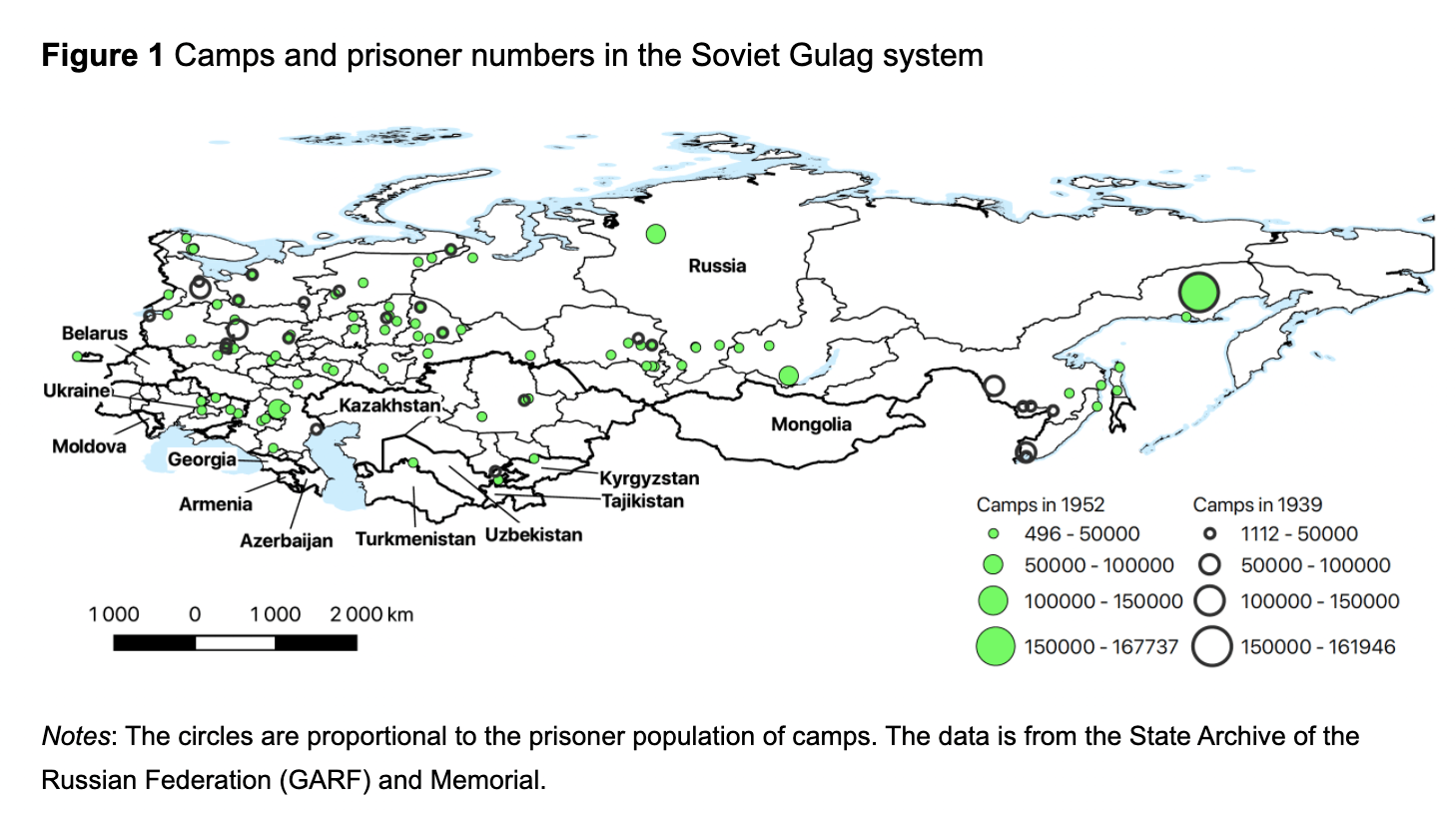
  • In a remarkable, recent paper, two researchers can show that in and around the camps where there were more “enemies of the people” – highly educated academics and artists – growth today is higher and creativity is flourishing. It is both a testament to the resilience of human beings and how creative people bring value and a grim reminder of the echoes of the Gulag that we can still hear in local economies.

    And the Gulag was vast. Lest we forget, the authors show a map of the different camps:

    Since many stayed in the areas to which they had been relocated, the research argues, we can see how those groups affected the local economies and cultures – how they boosted their development.

    Read more here.

    +
  • I attended an interesting seminar on utopias a few days back. The seminar has stuck with me for a couple of reasons. One is that I do not think Utopias matter much to us anymore in the West, we have converged on a single scenario for the future that does not really graduate to a full Utopia, and it is captured in the hopeless phrase “making the world a better place“.

    The idea of creating a heaven on Earth or radically re-thinking human society is very different. More’s Utopia – written half in jest, I think – was in a sense a therapy against the idea that there would be such a thing as the best place. Utopias remind us of their own internal inconsistencies, the fact that they are unable to exist in time and evolve. Utopias are end points, not unlike death or the thermo-dynamic dissipation of heat into an even distribution at the end of time.

    But this is but half a thought. If utopias are unable to organize us against the future, then what is it that we relate to? I gave a small intervention at the seminar, where I tried to dig into (with varied success it must be said) what the opposites, the antonyms, of “utopia” is.

    The usual candidates are things like other utopias or dystopias, but all utopias are the same – they are end points – and a dystopia is merely a utopia seen from another aspect. Just like the duck-rabbit all utopias, understood the right way, are also dystopias.

    The duck-rabbit. Utopias and dystopias are just like this; and the fanatic is aspect blind.

    A better candidate then, I think, is Nietzsche’s eternal recurrence and Darwin’s evolution. Nietzsche, after getting rid of God, individualizes time and then asks that we determine our happiness by asking ourselves if we would be content to live this same life over and over agin in every detail. That philosophical move dissolves collective time into shards of individualized time – and utopias cannot live outside of collective time. Individual lives, measured in their own right, never end with perfect states – but always end with death, and so they can never be organized in an ideal pattern. Darwin’s evolution is eternal time without intent and creator, and if Nietzsche individualized time, well, then Darwin de-humanizes it.

    Time individual and dehumanized then dissolves all possible utopias into nothing more than fantasies about a worlds of milk and honey, dreams of the perfect that are indistinguishable from death. This insight – that the utopian inclination is but a nuance of thanatos – brings Freud into the game, and suddenly we have the three hermeneutics of suspicion lined up; they are also the reapers of the utopian tendency in human thought.

    Utopian patterns are not sustainable under a hermeneutics of suspicion.

    But what replaces them? What vision? What produces our patterns of organization and organizes our path to the future? Incrementalism is hardly an answer – and perhaps the answer is the catastrophe. We have replaced our utopias and dystopias – these stable states – with the complete collapse of the catastrophe.

    Catastrophe, utopia, dystopia, future – they line up in a curious story about shifts in our mentalities. I need to read Blanchot.

    +